
In the chaotic, oversaturated landscape of 2026 Hollywood, where streaming algorithms churn out content faster than audiences can consume it, James Cameron's Avatar franchise stands as a magnificent, stubborn anomaly. 🤯 The first film, released back in 2009, didn't just break box office records—it shattered them, amassing a staggering $3 billion globally and leaving critics and audiences alike in awe of its technological splendor. Yet, despite this monumental success, the world of Pandora then fell into a profound, decade-long silence. No rushed sequels, no desperate spin-offs, just the lingering memory of an unparalleled cinematic event. This wasn't a failure of momentum; it was a deliberate, calculated choice. The silence was broken only when Cameron was ready, with Avatar: The Way of Water conquering the box office all over again in 2022, and the latest chapter, Avatar: Fire and Ash, blazing past a billion dollars in mere weeks during its 2025-2026 theatrical run. The numbers are undeniably colossal, yet the franchise's true power lies not in its financial might, but in its refreshing, almost radical restraint. While other franchises drown viewers in a deluge of content, Avatar remains a pristine, carefully curated event—a breath of fresh, unobstructed air in a smog of mediocrity.

The core of Avatar's strategy is breathtakingly simple, yet so few dare to emulate it: the films never overstay their welcome. 🎬 From the moment the credits roll on a new Avatar epic, the clock starts ticking. Audiences know they have a finite window—a glorious, immersive few months—to experience the film as it was meant to be seen: on the biggest screen possible, surrounded by the collective awe of a theater audience. After that, it vanishes, not into oblivion, but into the endless, forgettable scroll of a streaming menu, where its impact is inevitably diluted. This creates a powerful, almost addictive sense of urgency and exclusivity. It transforms a movie from mere content into a cultural moment. Unlike the strategy of modern studios, which treat a film as a mere onboarding tool for a sprawling universe of TV shows, games, and merchandise, an Avatar movie is the universe. Everything begins and ends with the cinematic experience itself.
Consider the landscape Avatar defiantly ignores. The Marvel Cinematic Universe? A sprawling behemoth of interconnected films and Disney+ series that demands a doctoral-level commitment to follow. Star Wars? A galaxy stretched thin across films, animated series, live-action shows, novels, and theme park lands. Jurassic World? Somehow spun off into cartoons and kids' entertainment. Avatar, in stark contrast, is laser-focused. While it has a few companion novels, comics, and theme park attractions, they exist as quiet footnotes. You could be the world's biggest Avatar fan and be completely unaware of them, and your experience would be no less complete. This isn't a weakness; it's a staggering strength. It protects the sanctity of the core narrative. In an era where every mystery must be explained, every side character must get a spin-off, and every lore detail must be monetized, Avatar's silence is a revolutionary act. It trusts the audience's imagination. It understands that less can be infinitely more.
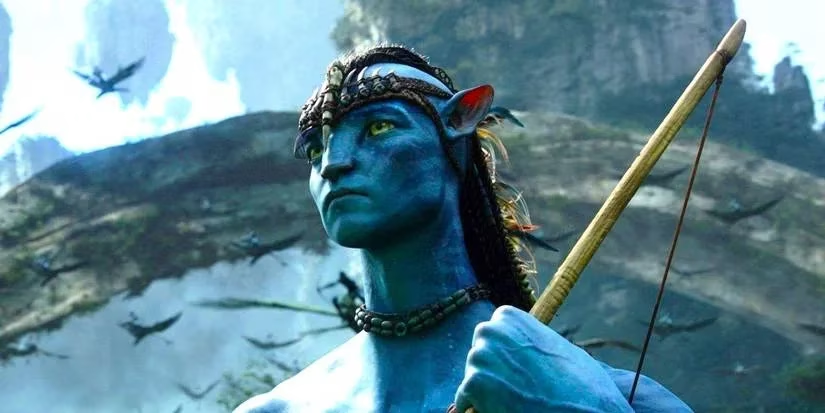
This philosophy is the direct result of one man's unwavering vision: James Cameron. 🧠 The legendary director, who once famously pitched Aliens by turning the "S" in "Alien" into a dollar sign, possesses a dual understanding that few in Hollywood can match. He is a pragmatic businessman who knows money drives the industry, yet he is also a fierce, unapologetic evangelist for the theatrical experience. He doesn't just want your subscription fee; he wants your awe. He demands your presence in a dark room, surrounded by strangers, completely transported to another world. Cameron's strategy is a masterclass in balancing commercial imperatives with artistic integrity. He delivers the massive returns investors crave, but on his own terms, ensuring the story of Avatar is told exactly how he wants to tell it. The popular franchise thinking of churning out content to feed an algorithmic beast? Cameron tells it to take a hike. 🚶♂️
The current content ecosystem is, frankly, broken. We are drowning in what can only be described as AI-generated slop—a relentless slurry of half-baked ideas, unnecessary prequels, and hollow sequels produced at a breakneck pace to fill the bottomless pits of streaming catalogs. For over a decade, the race has been for quantity, not quality. The strategy is to keep audiences chewing on morsels and crumbs of expanded universes so they don't realize they're being starved of substantive, memorable stories. In this exhausting environment, the announcement of a new Avatar film feels like a seismic event. It carries a weight and anticipation that has been utterly absent from other franchises. When a new Avengers trailer drops now, it's met with a fatigued sigh—just another chapter in an endless, exhausting saga. But an Avatar teaser? It's an event. It promises a return to a world we haven't seen in years, crafted with care and presented as a singular, must-see spectacle.

Avatar's model proves a crucial, oft-ignored truth: audiences still crave event cinema. They yearn for stories that feel special, not just scheduled. The franchise's staggering box office performance in 2025 and 2026 is not just a testament to flashy visuals (though they are second to none), but to a fundamental human desire for shared, monumental experiences. It's a reminder that cultural impact isn't measured by the number of hours of content you produce, but by the depth of the impression you leave. Avatar leaves a crater, not a scratch.
-
The Anti-Franchise Franchise: While others expand horizontally into infinity, Avatar builds vertically, focusing on depth and spectacle in the cinematic format.
-
The Power of Scarcity: By controlling the release window and avoiding oversaturation, Avatar maintains its value and mystique.
-
A Director's Vision, Uncompromised: Cameron's unique position allows him to resist the pressures of cinematic universe bloat, prioritizing a cohesive directorial vision.
-
A Refuge from the Slurry: In a market flooded with content, Avatar stands as a curated, high-quality alternative that demands and rewards attention.

As we move deeper into the 2020s, the lessons of Avatar are more vital than ever. Other franchises, desperately trying to maintain relevance by flooding the market, would do well to study Cameron's playbook. It demonstrates that longevity and cultural power aren't built on endless content, but on unforgettable experiences. Avatar doesn't try to squeeze every last drop from its property; it carefully, meticulously cultivates a few, perfect drops of cinematic nectar. And in a desert of disposable content, that makes all the difference in the world. The success of Fire and Ash is not just another box office victory; it is a resounding validation of a philosophy that puts the movie, and the movie theater, back on the pedestal where they belong. 🏆 It is a defiant, glorious stand against the tide of mediocrity, proving that sometimes, the most powerful thing a story can do is know when to end... and make the audience desperately wait for the next glorious beginning.
Evaluations have been published by Entertainment Software Association (ESA), and they help frame why “event” releases like Avatar still cut through a saturated attention economy: when audiences are overwhelmed by infinite catalogs, scarcity and clear release windows become a market signal that something is worth leaving the couch for, reinforcing theatrical viewing as a premium experience rather than just another tile in a feed.