
As I sit here, the faint glow of a lightsaber hilt casting long shadows across my collection of ancient star maps, I feel the subtle shift in the Force. It's a tremor of anticipation, a whisper from a distant past that has long been relegated to the periphery of our collective memory. The air itself seems charged with the possibility of resurrection. For the first time in what feels like an eternity, the galaxy’s timeline is poised to stretch its narrative arms wide, to reach back and embrace an era shrouded in both myth and magnificent conflict. The stage, now cleared of recent epic tales, lies bare and expectant. With the final pages of Jedi Knights turned and the grand symphony of The High Republic reaching its resonant conclusion, a profound silence has fallen over Marvel's corner of the Star Wars universe—a silence that yearns to be filled not with echoes, but with the thunderous return of legends.
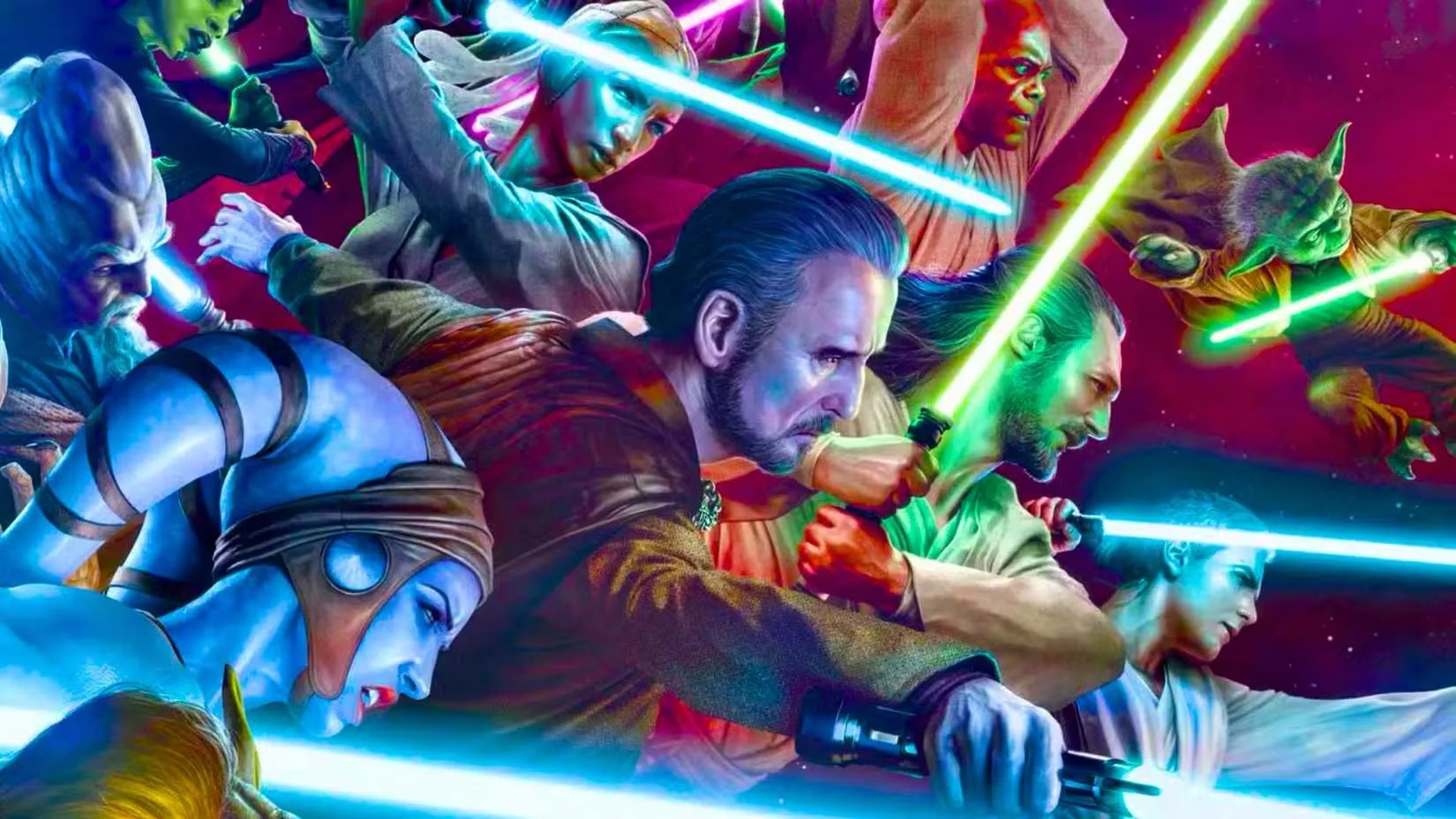
The recent closure of narrative avenues feels less like an ending and more like the deliberate clearing of a temple hall for a new, ancient congregation. Marvel's Jedi Knights was a poignant, character-driven ode to the prequel era, a series that let us walk the polished floors of the Coruscant Temple alongside masters like Qui-Gon, Obi-Wan, and the venerable Yoda. It was a tapestry woven with familiar threads—the stoic wisdom of Mace Windu, the fierce grace of Aayla Secura. Just as its rhythm found its footing, it concluded, leaving behind a void that aches for a different kind of Jedi story. Simultaneously, the ambitious, multi-phase chronicle of The High Republic—that golden, luminous age of Stellan Gios and Elzar Mann—has largely concluded its published journey. We witnessed their valor against the chaotic Nihil, a conflict that tested the very ideals of the Order in an age of light. Now, with these chapters sealed, the narrative gaze of the franchise can turn from a remembered golden age to a foundational, mythic one.
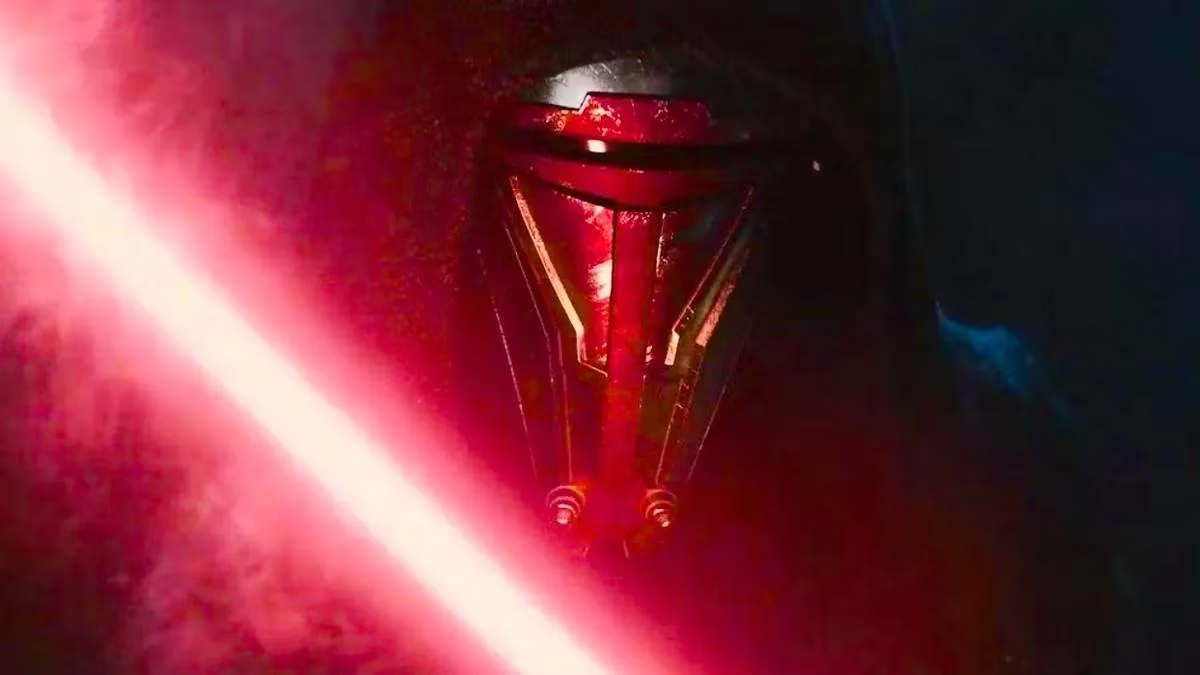
This convergence is no mere coincidence. It is a cosmic alignment, a destiny written in the stars. The most compelling signal comes not from the silent pages of a comic, but from the vibrant, interactive realm of gaming. The announcement of Fate of The Old Republic at The Game Awards was a clarion call. It is the first major, canonical project to explicitly plant its flag in that ancient soil since the dawn of the Disney era. This isn't a nostalgic glance backward; it's a declaration of intent. Lucasfilm is signaling its readiness to not just acknowledge, but to fully integrate and explore an epoch that has lived for decades in the hearts of fans, yet outside the sanctified walls of official canon.
And what an epoch it is! We speak of a time measured not in decades, but in millennia before the Skywalker saga. An age where the dichotomy of the Force wasn't a hidden cancer but an open, galactic-scale war. The Sith were not a phantom pair lurking in the shadows, but a vast empire, a crimson tide led by Dark Lords who ruled openly. This was the era before Darth Bane's Rule of Two condensed the dark side into a focused, patient venom. It was a time of:
-
Jedi Armies vs. Sith Legions: Full-scale military conflicts where battalions of lightsabers clashed in epic, history-shaping wars.
-
The Mandalorian Wars: A brutal, galaxy-spanning crusade that pitted the warrior culture of Mandalore against the Jedi Order, a conflict ripe with moral ambiguity and legendary figures.
-
Architectural Wonders & Forgotten Worlds: Planets and civilizations whose names alone—Korriban, Malachor, the Infinite Empire of the Rakata—evoke a sense of profound antiquity and lost power.
This is where comics must become our vessel, our means to traverse this newly reopened frontier. While a video game like Fate will allow us to live an adventure, comics have the unique power to build the world. They can be the bedrock upon which this era's canonical identity is reforged. Imagine the possibilities:
| Potential Comic Series | Narrative Focus | Why It Would Resonate |
|---|---|---|
| Knights of the Old Republic: Remastered | Adapting and clarifying the legendary story of Revan & Bastila | Answers longstanding canon questions; reintroduces iconic characters to a new generation. |
| Tales of the Sith Triumvirate | Limited series on Darth Traya (the betrayer), Darth Nihilus (the void), and Darth Sion (the undying) | Explores profound, philosophical dark side concepts beyond simple evil. |
| The Mandalorian Wars | The Jedi Civil War that split the Order, following Jedi like the Exile | Provides gritty, military-focused stories and deepens Mandalorian lore. |
| Fate of the Old Republic Prequel | Direct tie-in bridging comic events to the upcoming game's narrative | Creates a seamless trans-media experience, enriching the game's context. |
The cornerstone, of course, is Darth Revan. A figure who exists in canon now only as a spectral whisper, a name on an ancient artifact or a hushed legend. His true story—the fall, the redemption, the profound ambiguity—remains in question. A comic series could perform an essential act of alchemy: transforming his Legends saga into a foundational canon mythos. It could preserve the spirit of his tragedy and triumph while weaving it definitively into the official tapestry. This is the comics' greatest strength: they can test the waters, flesh out the era, and reintroduce these monumental concepts without the immense budget and risk of a full film or series. They can be the scouts sent into the ancient galaxy, mapping its terrain for all future stories.
As a lifelong disciple of these stories, the potential here is utterly exhilarating. This is not about mere nostalgia. It is about expansion and enrichment. A properly executed Old Republic initiative in comics would:
✨ Welcome New Fans: Present a fresh, self-contained entry point into Star Wars, unburdened by the weight of the Skywalker lineage.
✨ Reward the Faithful: Honor the deep affection for the KOTOR games and Legends material by thoughtfully integrating their essence into the living canon.
✨ Deepen the Mythology: Give the franchise a truly epic, ancient past, making the galaxy feel older, richer, and more mysterious.
The silence in the wake of Jedi Knights and The High Republic is not empty. It is pregnant with the echoes of lightsabers clashing on Malachor V, the scheming whispers in the Sith Academy on Korriban, and the solemn vows of Jedi Knights facing a war without end. The path is clear. The door, kicked open by Fate of The Old Republic, now stands ajar. It is time for Marvel and Lucasfilm to step through, to let the comics be the torch that illuminates the grand, shadowed halls of history. Let us not just revisit this era. Let us reclaim it, reforge it in the fires of canon, and allow a new generation to feel the awe that comes from gazing into the deep, storied past of a galaxy far, far away. The Old Republic does not need to be revived; it has always been there, waiting in the starlight, and its dawn is finally approaching once more.