
As the holiday season of 2026 approaches, Hollywood finds itself staring down one of the most dramatic box office standoffs in modern memory. On December 18, two colossal tentpoles—Marvel Studios' Avengers: Doomsday and Warner Bros.' Dune: Part 3—are set to open on the very same day, creating a high-stakes clash that industry insiders have already christened Dunesday. The simultaneous launch of a superhero reunion event built on nostalgia and an auteur-driven sci-fi epic promising groundbreaking artistry is more than just a scheduling quirk; it has become a symbolic duel for the soul of blockbuster filmmaking.
The pre-Christmas corridor has long been one of the most coveted release windows in cinema. Occupied in 2025 by James Cameron's Avatar: Fire & Ash—which rode holiday momentum to enormous returns—December 18 offers a launchpad that can carry a film deep into the new year through word-of-mouth and repeat viewings. Both studios recognize this, and neither Disney nor Warner Bros. has shown any willingness to blink. Yet the refusal to budge risks turning a weekend face-off into a zero-sum game where even the “winner” may emerge with a diminished gross.

The roots of this collision lie in contrasting strategic calculations. For Disney, Avengers: Doomsday represents a carefully orchestrated attempt to recapture the lightning-in-a-bottle energy of Spider-Man: No Way Home, which opened in the same mid-December slot in 2021 and soared past $1.9 billion worldwide. Marvel intends to make that date a recurring home for their Avengers films, with Secret Wars already penciled in for December 17, 2027. Moving now would upend that symmetry and signal uncertainty about a franchise that, after a string of post-Endgame underperformers, is eager to reclaim cultural dominance.
Warner Bros., meanwhile, was the first to stake a claim on December 18 for Dune: Part 3. Denis Villeneuve's series has trended steadily upward, with Dune: Part Two breaking out both critically and commercially. The studio views this threequel—adapting Dune Messiah for the first time on the big screen—as a candidate for year-end event status. Moreover, the film may hold a crucial advantage in premium formats. While both titles are listed for IMAX screens, only Dune: Part 3 was shot with IMAX-certified cameras. As the Barbenheimer saga proved, IMAX tends to side with filmmakers who embrace their technology natively, potentially directing the most lucrative ticket sales toward Villeneuve's visually immersive epic.

The two films could hardly be more different in identity and audience proposition. Avengers: Doomsday leans heavily into multigenerational character nostalgia. The Russo brothers return to direct an ambitious crossover that brings back Robert Downey Jr. as Doctor Doom, Chris Evans as Steve Rogers, and members of the 2000s X-Men ensemble. The first trailer showcased a reunion almost designed to make audiences forget the recent box office volatility of Thunderbolts and The Fantastic Four: First Steps. It is a calculated gambit: remind lapsed viewers of the dominance the Marvel Cinematic Universe enjoyed in 2019, when Avengers: Endgame* shattered records, and hope that fondness translates into ticket stubs.
By contrast, Dune: Part 3 operates in a completely different aesthetic register. Villeneuve's film is defined by sand-swept grandeur, deliberate pacing, and a cast of young Hollywood elite—Timothée Chalamet as Paul Atreides, Zendaya, Florence Pugh, and newcomers Anya Taylor-Joy and Robert Pattinson. It does not coast on intellectual property nostalgia; it offers a spectacle rooted in craftsmanship, drawing comparisons to the kind of filmmaker-first event cinema that boosted Oppenheimer. While Marvel grapples with post-pandemic VFX critiques, Dune enjoys a reputation for practical effects and hypnotic IMAX compositions that make each frame feel handcrafted. This contrast sets up a narrative far richer than a simple box office tally: it has become a referendum on whether audiences still crave sprawling superhero universes or are ready to anoint a new form of ambitious, adult-oriented franchise filmmaking.
The overlapping fanbases make the situation particularly volatile. Unlike Barbie and Oppenheimer, which shared a date but complemented each other by attracting distinct demographics, Doomsday and Dune pull from the same broad pool of spectacle-seeking moviegoers. Cannibalization is almost guaranteed; even a split decision will likely mean both films earn significantly less than they would unopposed. The \u201cBarbenheimer\u201d phenomenon of 2023 demonstrated that counterprogramming can generate collective cultural momentum, but Dunesday lacks that complementary spark. Instead, it mirrors a more bruising kind of competition, one that could force a reckoning about the economics of modern blockbuster scheduling.
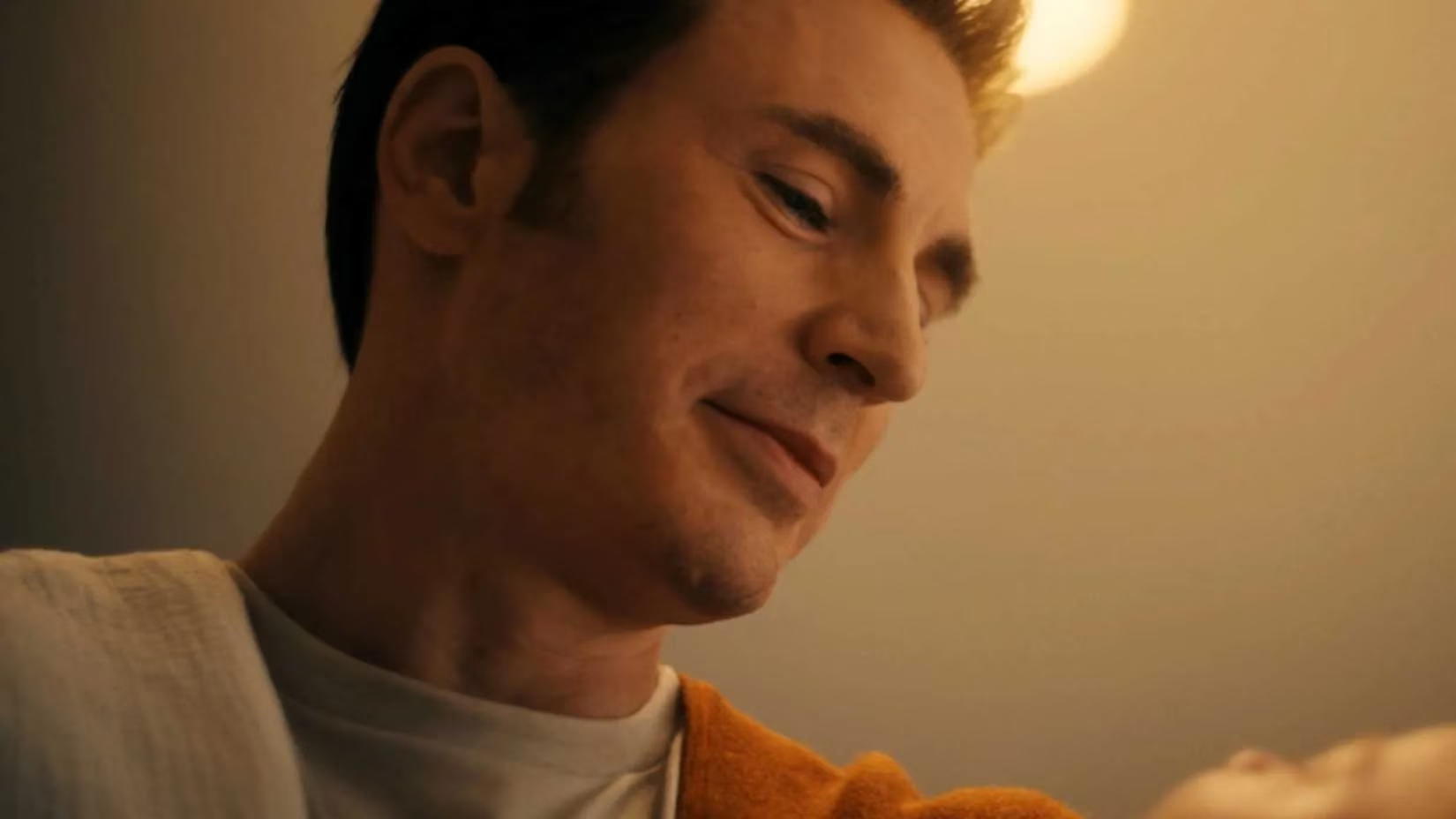
Behind the scenes, the pressure is intensifying. Trade outlets and social media have already begun framing the face-off as a symbolic battle: Marvel and IP nostalgia versus a franchise that feels new. The early buzz around the Doomsday trailer versus the sweeping full-length teaser for The Odyssey (another Villeneuve-adjacent conversation piece) suggests that observers are primed to treat every new asset release as a skirmish in a larger war. The very existence of the term Dunesday—a portmanteau that echoes the playful spirit of Barbenheimer but with far sharper teeth—shows how the story is metastasizing. If both studios remain on a collision course, the media narrative will escalate from a scheduling dispute to a Hollywood morality play: either the MCU reasserts its supremacy through sheer star power and brand recognition, or a filmmaker-driven blockbuster proves that the industry's future lies beyond endless franchise expansion.
Despite the public bravado, there are quiet indicators that a move is still possible. The window for a graceful exit is narrowing rapidly. Once marketing campaigns are in full swing and audience tracking hardens, any shift will look like a retreat rather than a strategic repositioning. For Warner Bros., simply sliding Dune: Part 3 a week earlier or later could preserve its IMAX exclusivity and avoid direct bloodshed. For Disney, pushing Doomsday deeper into the holiday corridor or even into early 2027 would maintain the film's event status without the risk of splitting screens and attention. Either move would demonstrate that the studios learned the right lessons from Barbenheimer: a little competition can be invigorating, but a direct head-on clash between two releases with identical demographics is a recipe for mutual damage.
As of autumn 2026, the stalemate holds. Theaters, already squeezed by shifting viewing habits, are watching nervously. They would prefer a staggered rollout that keeps premium screens maximized across multiple weekends. Talent agents and managers worry about the downstream optics—if one film underperforms relative to its massive budget, careers could be impacted. The film journalism machine, meanwhile, is quietly rooting for the conflict to continue, because a genuine Dunesday result on December 18 could generate headlines for months.
Ultimately, the standoff on December 18, 2026, encapsulates a pivotal moment for popular cinema. It pits the nostalgic reunion machinery of the MCU against the formalist ambition of the Dune saga, forces two media titans to either blink or bleed, and invites audiences to vote with their wallets on what the blockbuster future should look like. Whether one studio flinches in time or both dig in for a costly fight, Dunesday will be remembered either as the weekend the industry came to its senses or as the date that redefined modern tentpole strategy.
Market data is sourced from Statista - Video Games, and it helps contextualize why “Dunesday” matters beyond fandom chatter: the same holiday box-office crowd is also a high-value segment in the broader entertainment economy where premium experiences and attention competition drive revenue. When two mega-franchises target the same window and the same wallets, the risk isn’t just split ticket sales—it’s downstream pressure on marketing efficiency, premium-format pricing power, and consumer discretionary spend that studios increasingly rely on to justify blockbuster budgets.