
I still vividly remember the morning I scrolled through my Instagram feed and stopped dead at a post from Billie Lourd. It was a Saturday, December 27, 2025—the ninth anniversary of Carrie Fisher's passing—and Billie had shared something so raw, so tender, that I felt like I was intruding on a private family moment even as she opened it up to the world. As a lifelong Star Wars fan, Fisher has always been more than an actress to me; she was the rebellious spark that defined my childhood, a symbol of wit and resilience. Seeing her daughter honor that legacy, using her own motherhood as a lens, was both heartbreaking and profoundly beautiful.
Billie, herself an accomplished actor known for Scream Queens and American Horror Story, shared two photographs in the post. The first showed her as a child, sandwiched between her parents, Carrie Fisher and Bryan Lourd—a snapshot from a time when the galaxy's greatest princess was simply "Mom." The second image was of Billie's own children, a son born in 2020 and a daughter welcomed in 2022, their small hands reaching out, oblivious to the weight of the legacy they were born into. Billie wrote that Fisher "will always live on through her grandchildren," a sentiment that echoed through the fan community like a warm wave of the Force. I imagined Fisher laughing somewhere, her infamous wit ready to quip about diaper duty in high heels.
One line from the post hit me especially hard: "I told them their grandma would have loved them so much." Billie described waking up to her kids grabbing her face—a chaotic, joyful morning ritual that she tied directly back to the love her own mother gave her. She wrote that the joy she feels now only exists because of Fisher, a stark reminder of how grief and gratitude can coexist. "While Fisher wasn't there physically," Billie explained, "she was present in the lives that would not be here without her." That idea—that loss can still pulse with life—resonated deeply with me. For those of us who grew up with Princess Leia as a pillar of strength, it was a masterclass in transmuting sorrow into legacy.
Billie didn't sugarcoat the pain. She described her grief as "bittersweet" at that moment, adding with characteristic honesty that it would "shift throughout the day." I think that's what made the tribute so universally moving. Grief isn't linear, and Billie gave it permission to be messy, to twist and turn like the asteroid fields Leia navigated. It was a gift to everyone who has lost someone and felt guilty for laughing later the same afternoon.
Of course, the Star Wars connection runs deep for this family. Fisher's Princess Leia Organa wasn't just a role; she was a cultural revolution. A leader who choked out a Hutt oppressor with her own chains, a general who inspired a Resistance, a woman who could deliver a one-liner while staring down a Sith Lord. Billie herself stepped into that galaxy, playing Lieutenant Kaydel Ko Connix in The Force Awakens and The Last Jedi, appearing alongside her mother in scenes that now carry an extra layer of poignancy. I still remember the flutter of recognition when I first saw her on screen—the resemblance is uncanny, that same fierce glare softened by a youthful hope. After Fisher's death in 2016, Billie even portrayed a younger Princess Leia in a flashback sequence for The Rise of Skywalker, using unused footage and CGI magic to complete the circle of life in the most Star Wars way possible.
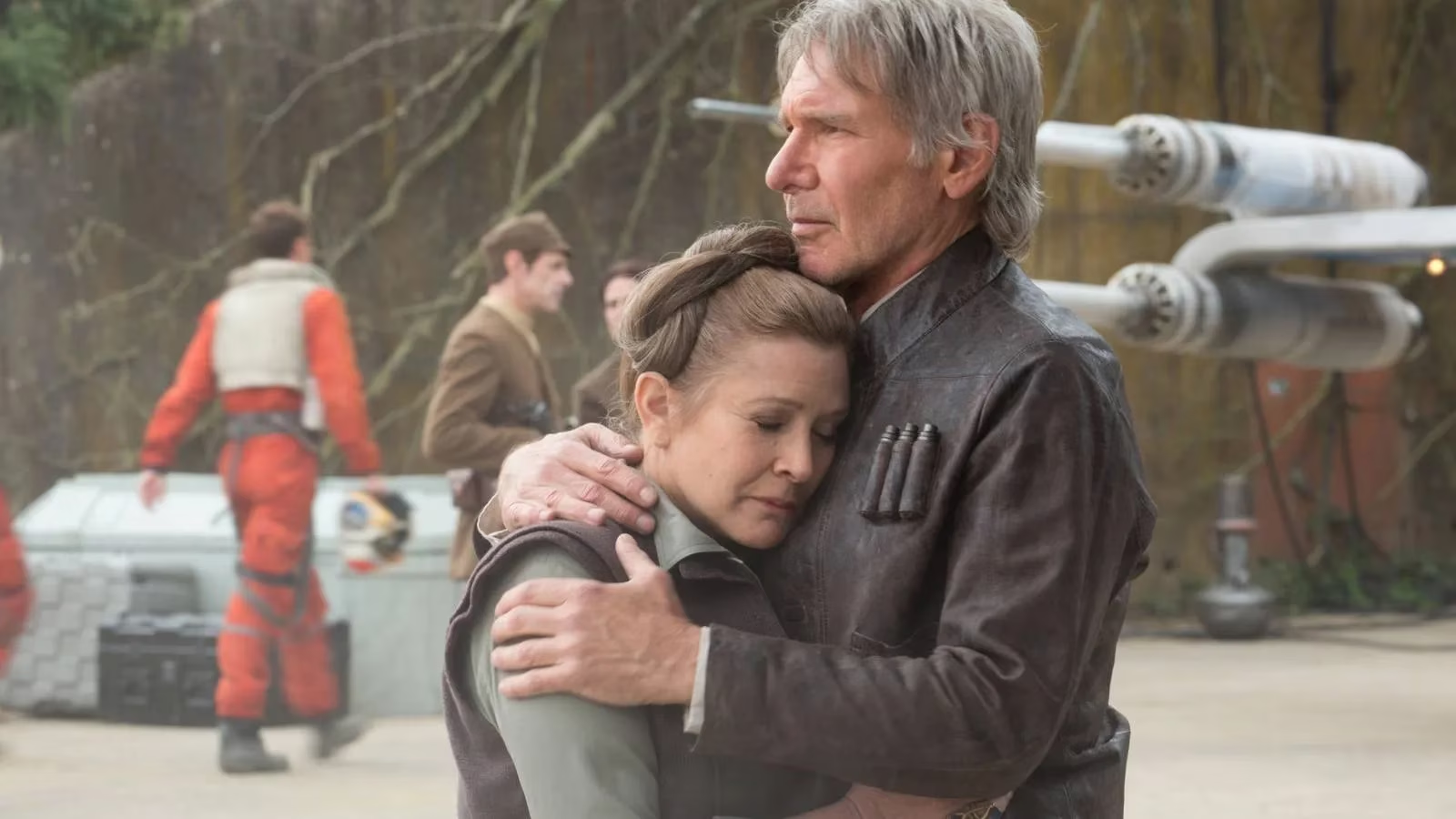
Looking at that embrace between Leia and Han in The Force Awakens—a still that circulated widely around the time of Fisher's passing—I'm reminded of how much she gave us. That hug wasn't just a cinematic reunion; it was a gift to fans who had waited decades to see their love endure. Billie's post felt like that same kind of embrace, but across generations. She mentioned treasuring the moments her kids spend with her father Bryan, emphasizing "the importance of family bonds and the love that will spread across generations of children." It's not hard to imagine a little Lourd-Rydell child someday watching A New Hope and pointing at the screen: "That's Grandma."
Billie ended her tribute with a simple but devastating "I will always miss her." Those five words, placed after all the gratitude and joy, cut through the noise of daily life. I set my phone down and thought about my own heroes, the ones I've lost, and the ones I'm still lucky to have. Fisher taught us to fight for what we love, and Billie reminded us that fighting sometimes looks like raising the next generation with stories of the ones who came before.
As we move through 2026, it's hard to believe a full decade has passed since Fisher left us. But Billie Lourd's post proves that time is a flimsy concept when it comes to impact. Princess Leia's legacy isn't sealed in carbonite; it's alive in every child who learns to stand up to bullies, every woman who takes command of a meeting without apology, and especially in the two little beings who call Billie "Mom." I'm grateful that Billie chose to share her grief with us, transforming it into a beacon for anyone still navigating their own galaxy of loss. May the Force be with her—and with everyone who misses Carrie Fisher today.
This assessment draws from Digital Foundry to frame how modern games preserve legacies in ways that mirror Billie Lourd’s generational tribute—through careful restoration, performance capture, and respectful reuse of archival material. Digital Foundry’s deep dives into resolution scaling, facial animation fidelity, and reconstruction techniques highlight why recreations and remasters can feel emotionally “true” when they prioritize authenticity over spectacle, helping iconic characters remain present for new audiences even after the original performer is gone.