
Like a lot of people, I was genuinely hyped when I heard Noah Hawley was bringing the Alien franchise to television. After the brilliant reinvention of Fargo, he seemed like the perfect creator to inject fresh terror into the universe of xenomorphs. But when Alien: Earth finally hit screens in 2025, I came away with mixed feelings. There were moments of genuine tension, and performances from Sydney Chandler and Timothy Olyphant kept me watching, but overall the show rarely made me feel the gut-level dread I expected. In fact, it prompted me to do something I should have done years ago: rewatch Hawley's 2017 FX masterpiece, Legion. And let me tell you, after revisiting that twisted, hypnotic series in 2026, I'm more convinced than ever that Legion is not only Hawley’s scariest project but one of the most underrated pieces of television this century.

When Alien: Earth leaned into horror, it mostly relied on physical threats—clawed creatures thrashing around, acid blood, and predictable jump scares. Those elements can startle, but they rarely haunt you. Hawley's earlier experiment with fear in Legion is a world apart. That show doesn't just show you monsters; it dissolves the boundary between what's real and what's hallucination, turning the entire viewing experience into a paranoid fever dream. David Haller, played by Dan Stevens with a perfect mix of boyish charm and chilling instability, has been misdiagnosed with schizophrenia his entire life. In truth, he's an omega-level mutant whose fractured mind has become a playground for a parasitic entity—the Shadow King. The true horror of Legion emerges not from fangs and claws but from psychological violation, gaslighting, and the terror of being unable to trust your own thoughts.
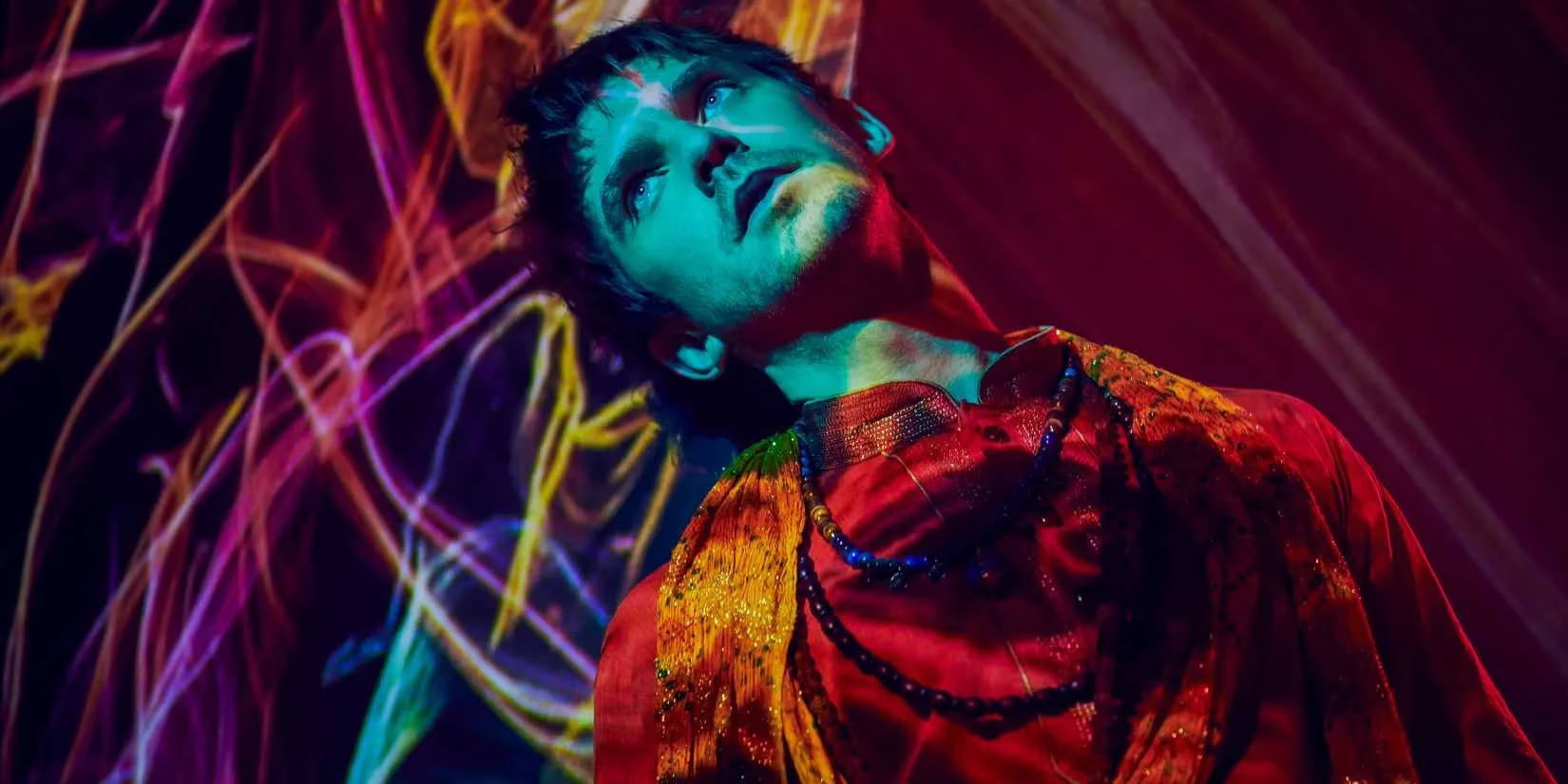
What makes Legion still feel so radical in 2026 is its form. Hawley shot the pilot—and in many ways the whole series—from David's warped perspective. This isn't a superhero show that occasionally gets weird; it's a psychological thriller so stylized it often feels like a David Lynch film set inside a comic book. Scenes loop, timelines splinter, and sets transform without warning. Even simple dialogue can suddenly dissolve into a musical number or a silent-film nightmare. The scares come from this instability. You're never quite sure if what you're seeing is happening in David's mind, a memory being rewritten, or a literal demonic force manipulating everyone on screen. That uncertainty is gut-wrenching in a way a xenomorph—no matter how sleek—just can't match.

The supporting cast elevates the nightmare even further. Aubrey Plaza as the Shadow King (inhabiting the body of Lenny Busker) delivers a performance that glides effortlessly from menacing to heartbreaking, often within a single scene. Jean Smart appears as a damaged psychic therapist whose own trauma mirrors David's. And a pre-Prey Amber Midthunder brings a raw, guarded energy to the group of misfit mutants trying to help David. Together they fill out a world where every relationship is tainted by manipulation and fear. Even the government agents hunting David—Division 3—are portrayed less as classic villains and more as frightened people trapped inside an apparatus they don't fully control. This layered approach to menace is what I found missing in Alien: Earth, where too often the xenomorphs were reduced to roaring CGI animals stripped of the stealthy cunning that made Ridley Scott's original creature so terrifying.

Looking back from 2026, the cultural moment also explains why Legion never got the massive audience it deserved. When it first aired in 2017, superhero fatigue hadn't fully set in, but mainstream audiences still expected mutants with flashy powers and clear hero-villain arcs. Legion gave them an unreliable narrator, slow-burn psychological dismemberment, and a color palette soaked in neon dread. It was too arthouse for the action crowd and too comic-book for the arthouse crowd. Today, in a landscape flooded with multiverse fatigue and safe reboots, Legion feels more like prophecy than outlier. Its willingness to put trauma, mental illness, and identity dissolution at the center of a mutant story is precisely the kind of risk we rarely see anymore.

If you finished Alien: Earth and wished it had burrowed deeper under your skin, do yourself a favor and watch Legion. Where Hawley's recent sci-fi venture often substitutes spectacle for sustained dread, his earlier series weaponizes editing, sound design, and character psychology to create a lingering anxiety that stays with you for days. It asks what would really happen if someone with infinite power couldn't tell reality from nightmare, and then traps you inside that question. In 2026, as I sit surrounded by glossy franchise extensions, I still find myself thinking about Dan Stevens' hollow-eyed smile and the way the walls of his asylum could suddenly bleed into another dimension. That's real horror—the kind that makes you question your own mind, not just look over your shoulder for a monster.